
Guides / Motion
So you want to add motion? Read this before you spend the money.
What a platform can and cannot do, what wrecks installs, and the cheaper route most people should try first.
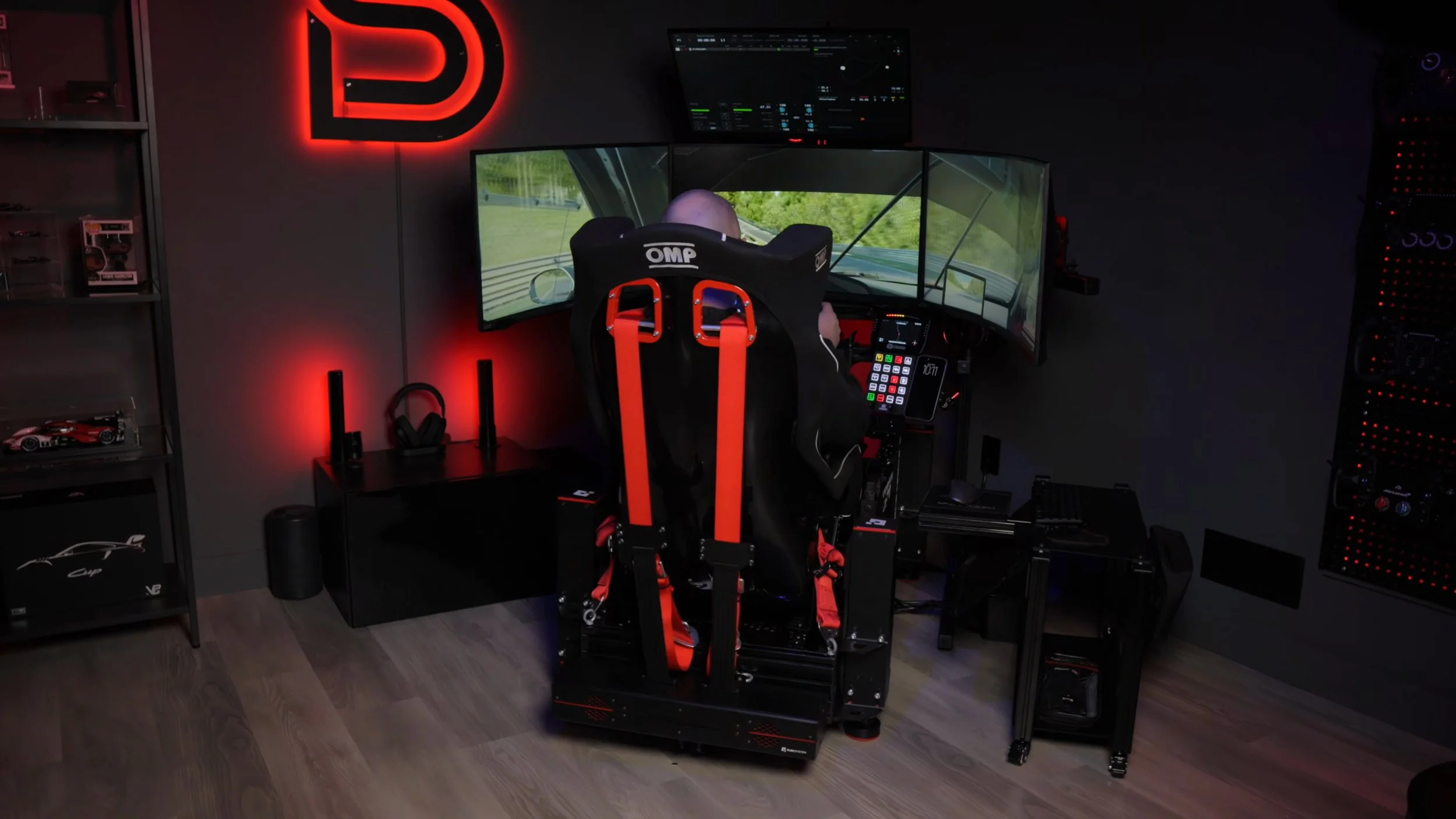
I run a Qubic QS-210 — four actuators under the cockpit, 2.5 degrees of freedom — with a QS-BT1 belt tensioner on the harness. I have also tested and reviewed the D-BOX G3 and written the comparison between the two.
So I am not going to tell you motion is life-changing and leave it there. It is the most physically involved upgrade you can make to a rig, and it is the one most likely to cause problems you did not plan for.
Here is the thing nobody selling motion will lead with:
Motion is not your next upgrade. For most people it is not the one after that either.
A platform that moves your entire cockpit changes your room, your cable routing, your screen mounting, your floor, and what your family hears through the ceiling. It rewards a rig that is already sorted. It punishes one that is not.
That is not a reason to avoid it. It is a reason to arrive at it in the right order.
Check current brand offers and eligibility →
This is buying and planning guidance, not a benchmark of every platform mentioned. My original video is linked at the bottom — read its pricing and product advice in its original context. The linked discount directory contains affiliate links that may earn me a commission at no extra cost to you, and discounts apply only where explicitly listed.
The short answer
Fix these first. All of them.
| Before motion | Why it comes first |
|---|---|
| A chassis that does not flex | Motion amplifies every weakness in the frame |
| A seat and harness you can sit in for an hour | You are about to be moved around in it |
| Pedals mounted rigidly | A shifting pedal face under braking ruins the cue |
| Stable frame rate at a full grid | Motion runs off telemetry. Stuttering telemetry, stuttering motion |
| Room you have actually measured | Including the space the rig sweeps through |
If any of those is unresolved, spend the money there instead. You will feel it more.
Then, if you want physical feedback, start with the cheap end.
This is the part that costs me commission to say. A belt tensioner and a set of tactile transducers will give you a real share of the physical sensation for a small fraction of what a motion platform costs, and they install in an afternoon without touching your room. I run a tensioner alongside my platform and it does work a moving cockpit cannot — sustained pressure through the harness under braking, which a platform can only hint at by tilting.
If you try that and still want the cockpit itself to move, then you want motion, and you will know why.
When you do buy:
| Your situation | What I would look at |
|---|---|
| Tight room, shared building, or renting | Seat mover, or tensioner and transducers only |
| Dedicated space, rig already sorted | Whole-cockpit platform |
| Triple screens already mounted | Whole-cockpit — and solve screen clearance before ordering |
| Mostly want detail and texture | Transducers. You do not need a platform |
| Chasing lap time | Neither. Buy practice |
The single most expensive mistake: ordering the platform before you have worked out where your monitors go. A cockpit that moves under fixed screens needs clearance through the full range of travel, and people discover this after delivery.
What motion actually does — and what it physically cannot
A motion platform reads telemetry from a supported sim and turns it into movement: pitch as you hit the brakes, a jolt over a kerb, roll as the car takes a set through a corner.
Here is the limit nobody puts on the box. Your rig has a few centimetres of travel. A real car has a whole corner.
A platform cannot reproduce sustained lateral load. It cannot hold you against a long right-hander the way an actual car does, because to do that it would need to keep accelerating in one direction — and it runs out of travel in a fraction of a second.
So it does something cleverer. It gives you a sharp initial cue — the onset of the load — then washes back toward centre slowly enough that you do not notice the return. Your inner ear reads the onset and fills in the rest. That is the entire trick, and it is why the quality of a motion system lives in the software far more than in the actuators.
It is also why a small, perfectly-timed movement beats a big one that arrives late. A dramatic demo video tells you almost nothing about whether a platform feels right.
“Motion makes you slower” — is that true?
You hear this said a lot, usually flatly, and it is worth answering rather than stepping around. There is something real behind it.
My read: motion will probably make you slower at first, and it will keep you slower if you set it up badly. Three reasons, all of them genuine.
- You are re-learning your references. Braking points and turn-in cues you had burned in on a static rig now arrive while your body is moving. Re-learning costs lap time for a while, and that while is longer than most people expect.
- An aggressive profile is a distraction. This is the big one, and it is the reason most of the “motion made me slower” stories exist. Turn everything up to the setting that impresses visitors and you spend the session reacting to the platform instead of the car. Restrained profiles are faster profiles.
- Movement makes the screen harder to read. Your head is moving relative to fixed monitors, so fine visual detail — a braking board, the edge of a kerb — is not as crisp as it is on a static rig. In VR this becomes the motion-compensation problem covered further down.
The case for the other side is that motion gives you earlier information: the moment the rear starts to go, the point the tyres load up. Some drivers genuinely use that. But it is information you can also read through force feedback and sound, which is why a lot of very quick people never bother with a platform. Motion is uncommon at the sharp end of sim-racing esports — the fastest drivers in the world are mostly sitting on static rigs.
So if lap time is the goal, motion is not how you buy it. Practice, a consistent seating position and clean racecraft are, and they are cheaper.
Where it does help is staying with the car once you are used to it: catching a slide a fraction earlier, feeling a kerb you would otherwise only have seen. Treat that as something you grow into over weeks, not something that shows up in your first session.
Buy motion because you want to feel the car move. If you end up quick with it too, treat that as a bonus rather than the reason.
Degrees of freedom, decoded
This is where the marketing gets slippery, so it is worth ten minutes.
Six degrees of freedom exist. Three are movements along an axis, three are rotations:
| Movement | What it feels like |
|---|---|
| Surge | Forwards and backwards — braking and acceleration |
| Sway | Side to side — lateral load |
| Heave | Up and down — bumps, kerbs, crests |
| Pitch | Nose up or down — the main braking cue |
| Roll | Leaning left or right — cornering attitude |
| Yaw | Rotating flat — the rear stepping out |
The number of actuators is not the number of degrees of freedom. This is the single most misread spec in motion.
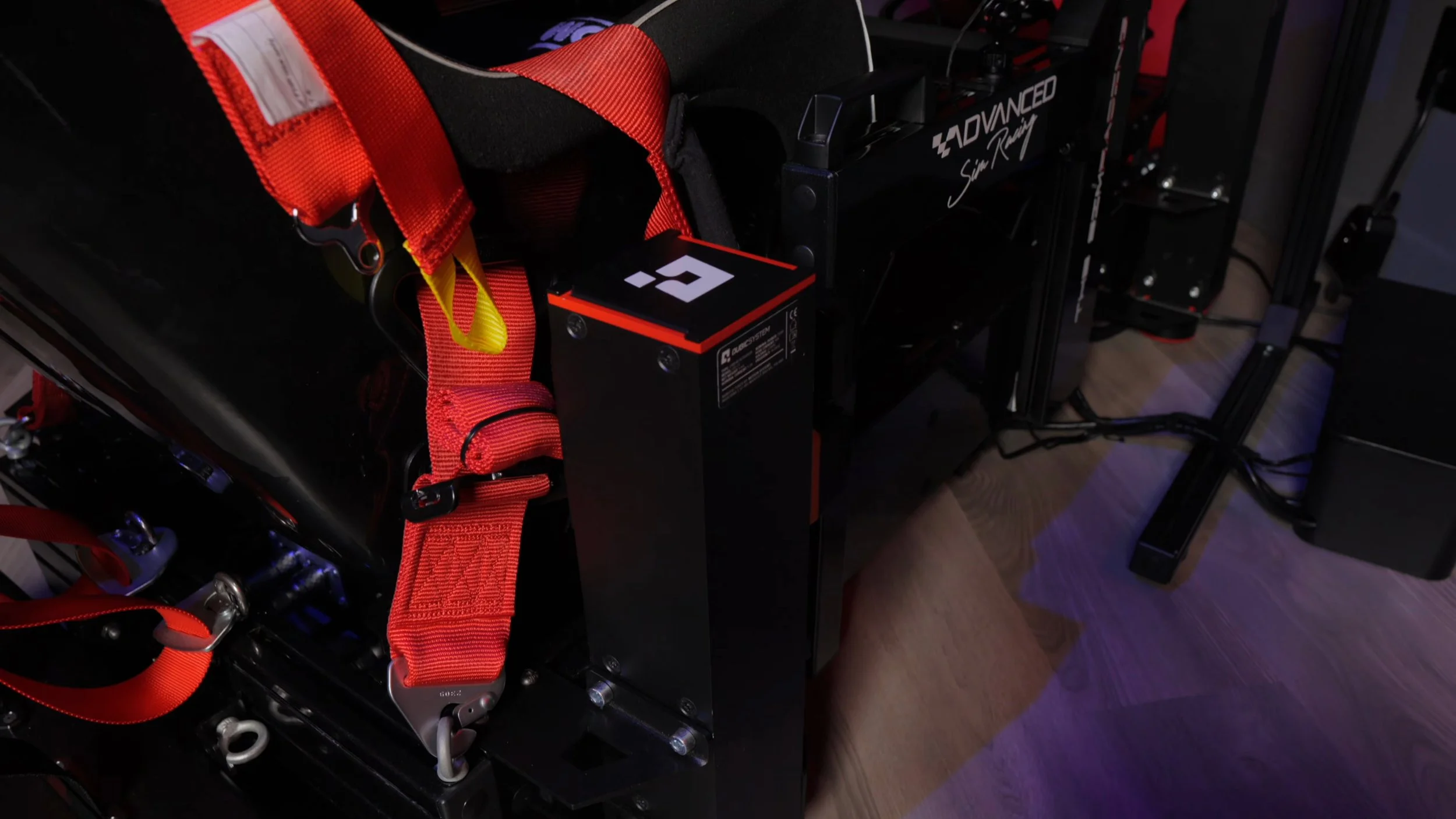
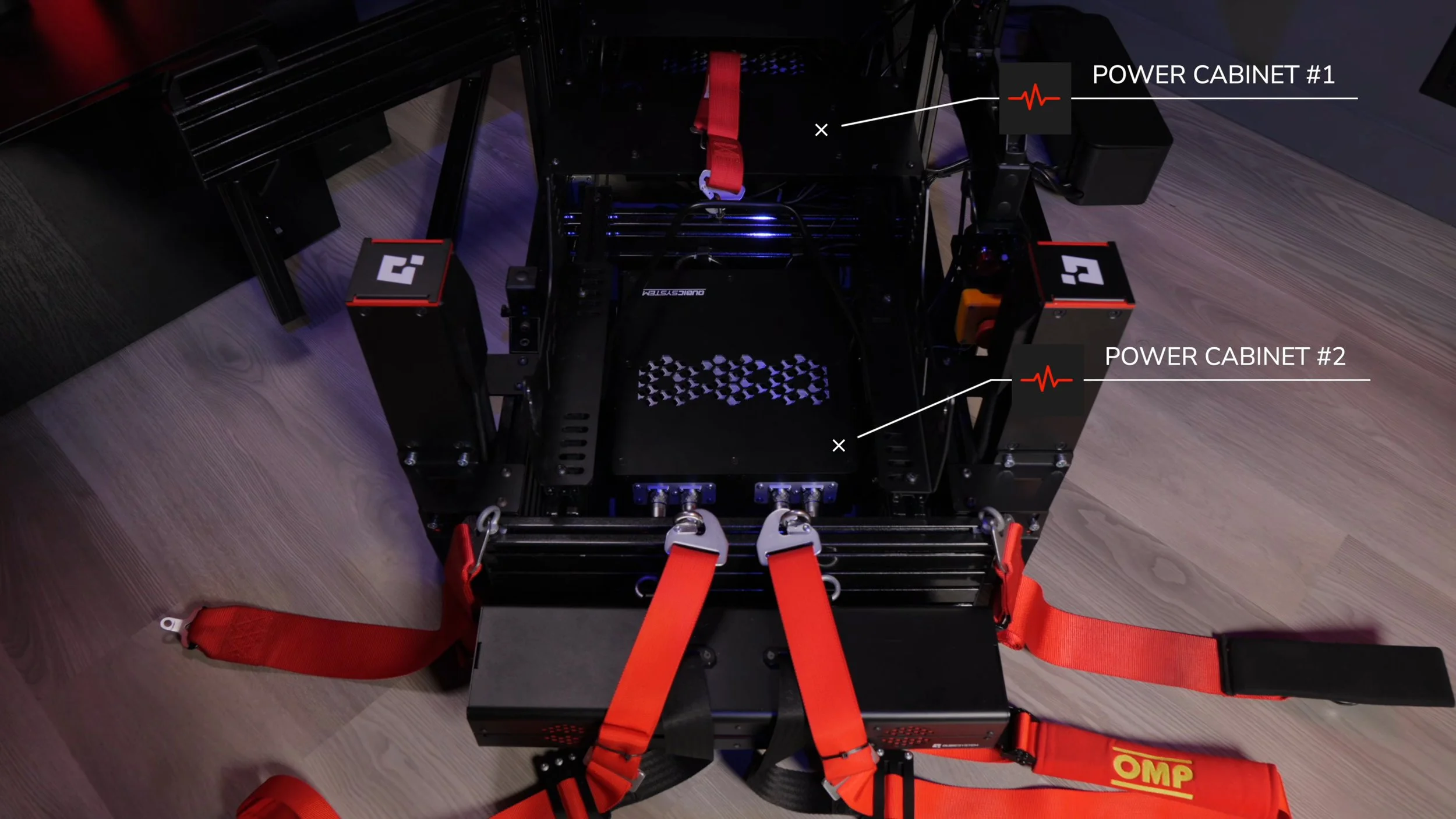
Four vertical actuators under a cockpit — which is what I run — work together to produce heave, pitch and roll. Four actuators, three degrees of freedom. They cannot produce sway, because none of them pushes sideways.
So when you see “2.5DOF” or “3DOF” or “4DOF”, do not take the number at face value. Ask one question: which movements can this platform control independently? A half is somebody’s judgement call about a partial axis, not a standard.
And more axes is not automatically better for a home rig. A 6DOF platform has more capability, more cost, more footprint, more mass to move and more to go wrong. What matters is whether the movements it does have are well-timed and well-tuned. A tight 3DOF platform with good software beats a sloppy 6DOF one.
Seat mover or whole cockpit?
This is the first real fork, and it is decided mostly by your room.
A seat mover moves you while the wheel and pedals stay put. It is cheaper, lighter, and far easier to live with — no rethinking your screen mounting, much less mass in motion.
The compromise is real though: the distance between your body and the controls changes as you move. For some people that is a non-issue. For others it makes the pedals feel inconsistent under braking, which is exactly where you want consistency. You need to try one.
A whole-cockpit platform moves the seat, wheel and pedals as one. Your relationship to the controls never changes, which is why it feels more like a car. It is what I run.
The cost is everything around it. The platform has to carry the whole assembly, the load has to be distributed the way the manufacturer specifies, and anything mounted to the rig now moves with it — which brings us to screens.
Traction loss and extra stages add a genuinely different sensation, particularly rear rotation. They also add another module, more footprint and another thing to install and maintain. Worth it if drifting or loose-rear driving is your thing; overkill if it is not.
The four things that wreck motion installs
None of these are about the platform. All of them are why people end up disappointed.
1. The moving load is bigger than you think
It is not your body weight. Depending on the design it is the chassis, seat, wheelbase, pedals, every bracket, every accessory — and possibly your screens.
Where that mass sits matters as much as how much of it there is. A heavy wheelbase cantilevered out front loads the platform differently than the same weight sitting under the seat.
Use the manufacturer’s own definition of payload and their mounting requirements. Do not invent your own safety margin and do not assume that because the total is under the number, the distribution is fine. Qubic publishes configuration-specific documentation for the QS-210 and distinguishes between its arrangements — that is the level of detail to look for whatever you are buying.
Source: Qubic System QS-210 documentation
2. The rig sweeps a volume, not a footprint
The parked dimensions are the beginning. What you need is the space the rig passes through at full travel, plus clearance to get in and out while it is installed.
Measure it before you buy. Then check what is in that volume: the desk, the wall, a radiator, the door.
3. Your screens are now a problem
This is the one that catches people, and it is worth its own section.
If your monitors are on a separate stand and the cockpit moves, the gap between you and the screens changes constantly — and the rig travels toward them. If your monitors are mounted to the rig, they move with you, which looks right but puts significant mass high up on the platform, exactly where you least want it.
Here is how I do it, and it works well.
My monitors sit on their own stand, in front of the chassis — not attached to the rig. Then the setup order is what matters:
- Check the platform’s maximum range of travel first. Not its parked position. The furthest forward it will ever come.
- Set the monitor stand distance from that. The screens go far enough back that the rig can never reach them at full travel.
- Then calculate your field of view for that distance, using your actual measurements — screen width, bezels, eye position.
Do it in that order and the result is genuinely convincing. Do it backwards — position the screens where they feel right, then bolt in a platform — and you will either be moving the stand afterwards or living with a rig that lunges at your monitors under braking.
The honest trade: motion puts your screens further away than a static rig would. You give up sitting as close as you otherwise could. Correct FOV for the new distance is what buys most of that back, which is why step 3 is not optional. My display guide covers FOV and triple projection in detail.
Both arrangements work. Neither is free. Decide which one you are doing, confirm the platform supports it, and check clearance through the full range of travel — not with the rig parked.
4. Noise and vibration travel further than you expect
Motor noise is the part you can hear in a demo room. The part you cannot is structure-borne vibration moving through the cockpit into the floor and out through the building.
If you are in an apartment, a semi, or upstairs over someone’s bedroom, take this seriously before you order. Ask specifically about isolation requirements and the recommended mounting surface. A showroom on a concrete slab tells you nothing about a first-floor bedroom on joists.
Check the electrical requirements and what servicing looks like too. These are ownership questions, not footnotes.
Software matters more than the actuators
I said earlier that the trick of motion lives in the software. Here is what to actually check.
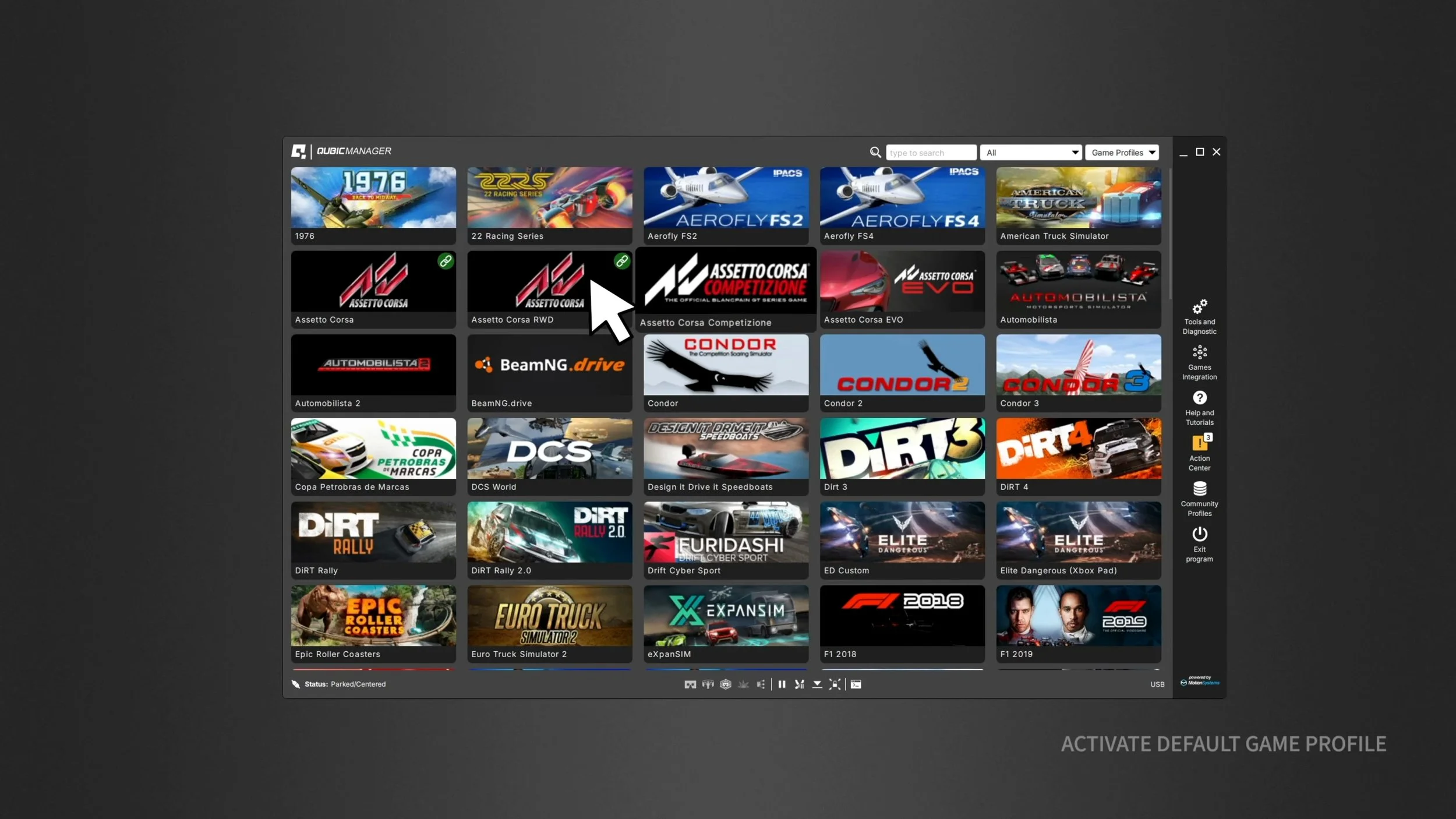
Does it support the sims you play? Not “supports major titles” — yours, by name. And ask what happens when that sim updates. Motion software that breaks every time iRacing pushes a build is a different product from one that does not.
How does tuning work? You will spend real time on profiles. Find out whether adjustment is a few sliders, a full effects editor, or a config file. All three can be fine; you just want to know which one you are signing up for.
Are there licences beyond the hardware? Some features, integrations or continued updates sit behind additional cost. Establish that before you compare prices, or you are not comparing prices.
What does support look like? Documentation, diagnostics, and a human when something stops working. You are buying a mechanical system that lives in your house for years.
Manufacturer software is often simpler to get running. Third-party software is often more flexible. Neither label tells you which feels better — that is down to the specific implementation.
Reading the spec sheet honestly
Travel, speed, acceleration, payload and latency all matter. None of them ranks platforms on its own.
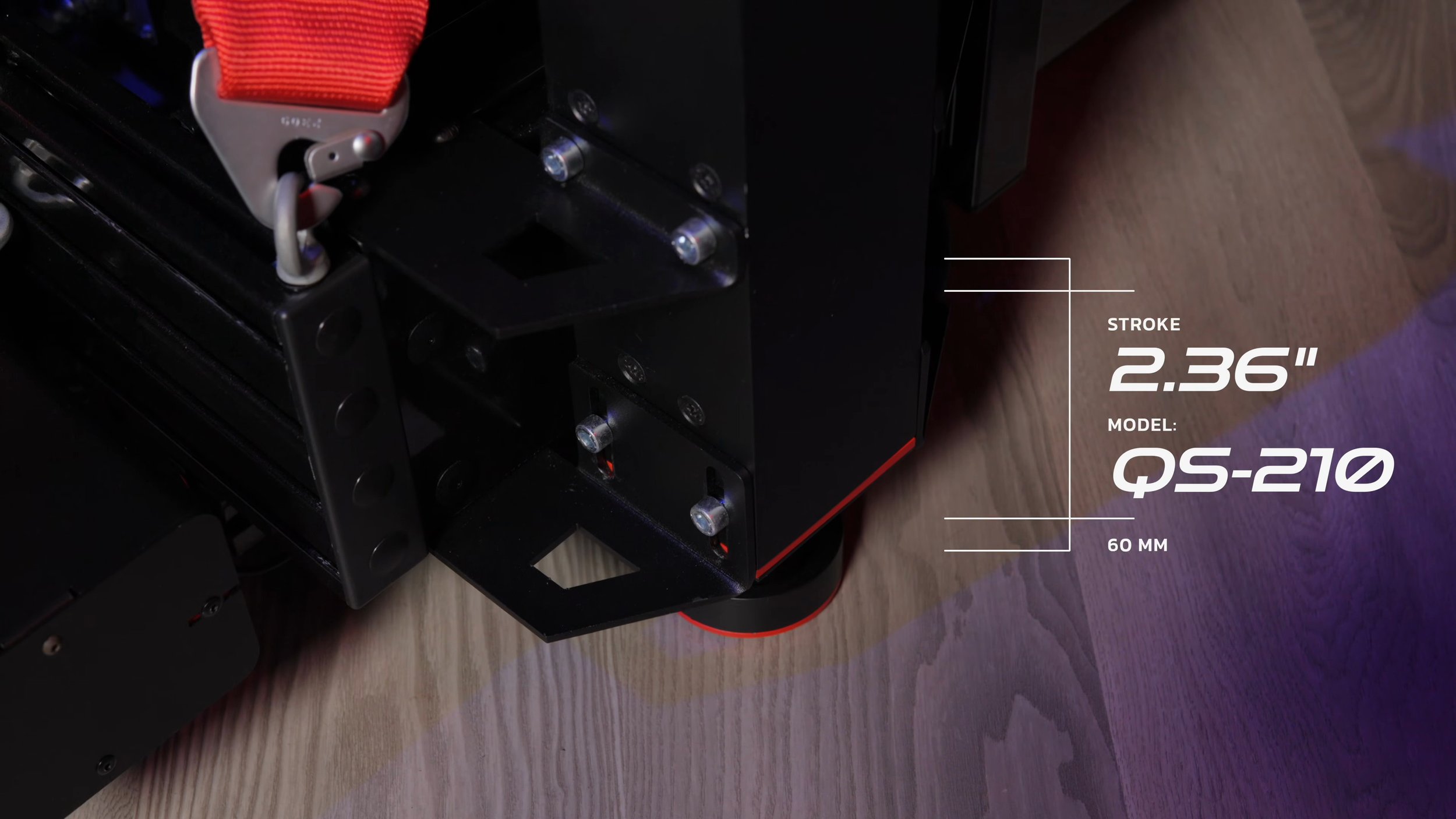
Travel tells you the size of the biggest possible movement. It says nothing about how accurately the system reproduces a short, sharp cue — which is most of what you actually feel.
Speed and acceleration figures depend entirely on load and configuration. A number measured unloaded is not the number you will get.
Latency is the sneaky one. A quoted controller response time is not the same as the delay from the sim generating telemetry to your cockpit physically moving. Those can be very different numbers. Ask which one you are being given.
Ask manufacturers to explain their figures and to compare like-for-like configurations. A company that answers that question clearly is telling you something useful about itself.
If you race in VR, read this twice
Motion and VR together create a problem that does not exist with screens.
The headset tracks your head in space. When the platform moves the whole cockpit, the headset sees that as you moving your head — so the virtual world shifts when it should have stayed still. The effect ranges from mildly wrong to genuinely sickening.
Motion compensation is the fix. It subtracts the platform’s contribution from the tracking data so only your actual head movement gets through. Implementations differ: some read data directly from the platform, some use an external tracking reference mounted to the rig.
Source: Motion Systems on VR and motion compensation
What you need to confirm, specifically and together: your headset, your runtime, your sim, and your motion software. All four. Compensation working for someone else’s combination tells you nothing about yours.
And compensation is not a comfort guarantee. Start with a conservative profile and build up. If VR already makes you queasy, adding motion is not the cure — it is at least as likely to be the opposite.
The cheaper route most people should try first
I mentioned this at the top; here is the detail, because it is the most useful thing in this article for most readers.
Tactile transducers bolt to the rig and vibrate it in response to supported effects — engine, road surface, wheel lock, gear shifts. They are inexpensive, they install in an afternoon, and they give you a surprising amount of the texture people buy motion hoping for.
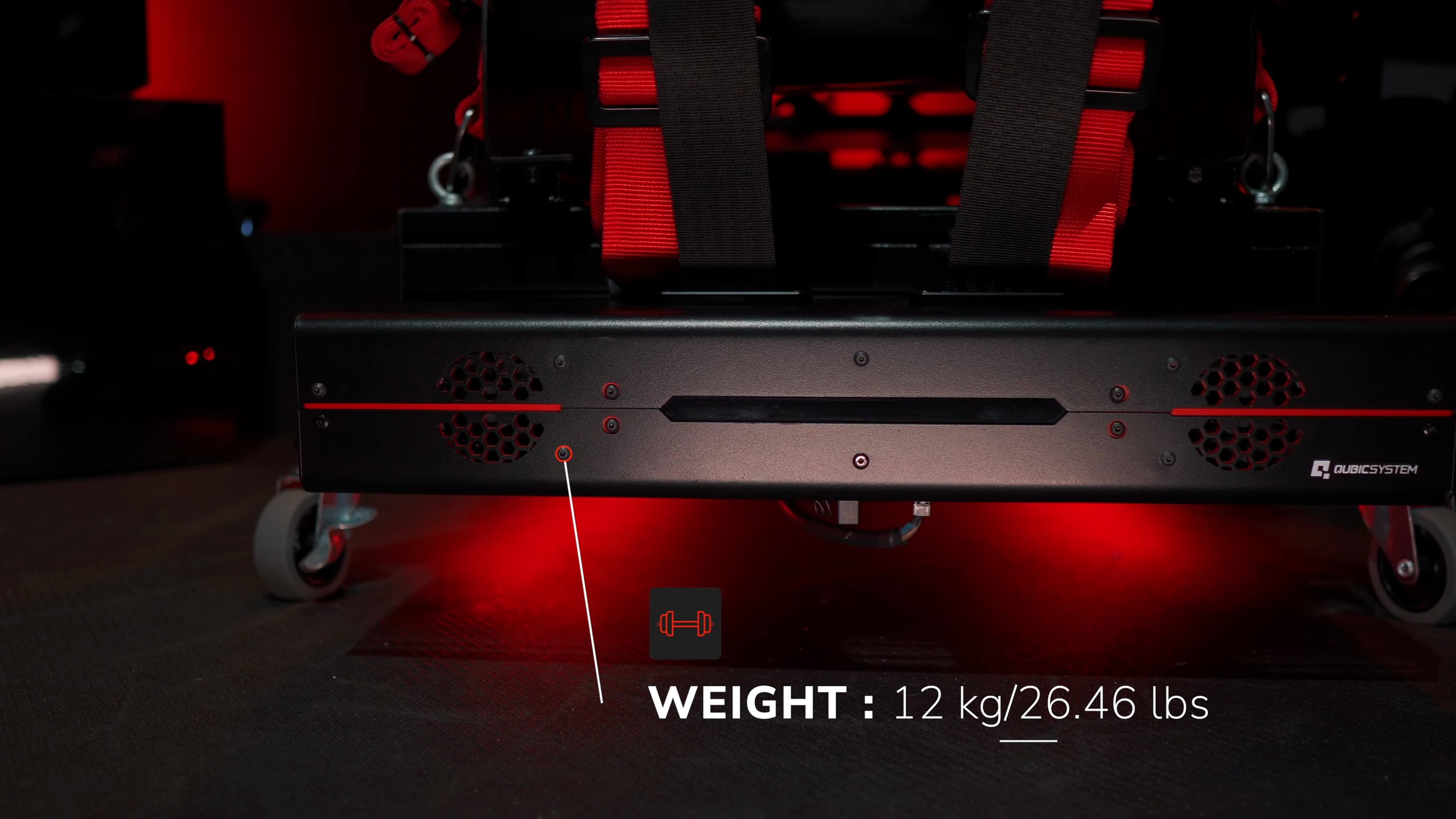
A belt tensioner pulls your harness tight under braking. This is the one that surprises people. A motion platform suggests braking load by pitching the cockpit forward; a tensioner puts actual sustained pressure on your body, which is closer to what the real thing does to you. I run a QS-BT1 alongside my platform, and the two do genuinely different jobs.
They have their own requirements — a tensioner needs a suitable seat, a proper harness and a supported mounting arrangement — but nothing like the planning a platform demands.
So the honest sequence is: transducers → tensioner → platform. Work up it. Stop wherever you are satisfied. Plenty of people stop before the platform and are perfectly happy, and that is a good outcome, not a failure.
If you want detail and texture, you do not need a motion platform. If you want the cockpit to move, nothing else will do it.
Why I kept the one I kept
I have had both the Qubic QS-210 and the D-BOX G3 on my rig, and the QS-210 is the one that stayed.
It felt more connected and more lively — quicker to respond, so the cue arrived when the car did rather than a beat behind it. The hardware also felt more premium to me in the way it was built and finished.
I want to be clear that this is preference, not a verdict. Both are capable platforms, and someone else could sit in the same two rigs and come away the other way round. What I can tell you is what the difference actually came down to for me: responsiveness and how immediate the movement felt, not travel figures or degrees of freedom.
Which is really the argument for the next section.
Before you commit, try it properly
If you can get a demo, take a car and track you know well. You cannot judge motion in a car you have never driven — you have no baseline for what it should feel like.
Ask for a restrained profile, not the showcase one. Then pay attention to whether the braking transition, the kerbs and the direction changes feel connected to what you are seeing and feeling through the wheel. Disconnected motion is worse than no motion.
Run a normal session length rather than three laps. The novelty wears off in about ten minutes, and what is left is what you are buying. Notice the noise. Notice whether you are still comfortable. Notice whether the cues have become helpful or just busy.
And ask to see the software and the setup process, not just the driving. You are buying years of ownership, not one demo.
Watch the original video
I walk through this with the rig in front of me. It went up in October 2025, so treat the specific products and prices in it as a snapshot of that moment — the written guidance above is where the current buying advice lives.
Planning a motion build?
Check the discount directory before you order. A brand appearing there does not mean every motion product carries a discount — codes, affiliate-only links and restrictions are listed per brand.
Going deeper
- Qubic QS-210 vs D-BOX G3 → — two platforms compared directly, both of which I have used.
- Qubic QS-210 review → — the platform I run, in detail.
- QS-BT1 belt tensioner review → — the cheaper upgrade I keep recommending.
- Monitors, triples or VR? → — the display guide, including FOV for a moving rig.
- My setup → — the full parts list for the rig in this article.