
Guides / Hardware
So you want to build a sim racing PC? The worst year in a decade to buy one.
What sim racing actually asks of a PC, what to refuse to buy in 2026, and how not to waste money.
I did not build the PC that runs my rig. Not in one go, anyway.
I built a PC, years ago, and it has been an ongoing evolution ever since — tweaked, upgraded, parts swapped as they made sense. I could not tell you when the machine in my rig today became the machine in my rig today. I used to run Intel. I run a Ryzen 7 9800X3D now, and I find AMD much better for this.
That is worth saying up front, because almost every sim racing PC guide is written as though you are starting from nothing on a Saturday afternoon with a credit card. Most people are not. Most people already own a PC and are trying to work out whether to fix it, feed it, or replace it.
In September 2026, that distinction matters more than it has in years — because the PC market is in the middle of a genuine crisis, and the usual advice is actively wrong.
Here is what nobody else will tell you: the one component sim racing depends on most is the only one that got cheaper this year. Everything else is in an AI-driven shortage that has roughly quadrupled the price of memory. Which means the right move in 2026 is not the one you would have made in 2024.
This guide is not a parts list. It is an explanation of what sim racing actually asks of a PC — which is genuinely different from what games ask of one — followed by what I would and would not spend money on right now.
Check current brand offers and eligibility →
This is planning and spending guidance, not a benchmark of every component mentioned. All prices in this guide are in US dollars, and are street prices as of September 2026. They are moving fast — check before you buy. The linked discount directory contains affiliate links that may earn me a commission at no extra cost to you.
The short answer
If you do not want the whole article, this is where I would point you.
| If this is you | What I would do in 2026 |
|---|---|
| You already have a working PC | Do not replace it. Find out what is actually limiting you first — it is probably not the part you think |
| Your CPU is old and your GPU is fine | Change the CPU. This is the cheap upgrade right now and it is the one sim racing rewards |
| Running one screen, thinking about triples | Budget for the screens and the graphics card together. Three screens is four times the work of one |
| You need a whole machine right now | Buy less memory and less storage than you think, and do not compromise on the CPU |
| Choosing between a faster CPU and a faster GPU | CPU, in this genre, more often than not |
| You were planning a custom watercooling loop | Do not. See the last section |
| You want the best of everything | Wait, if you possibly can. Memory prices are forecast to get worse before they get better |
The single most expensive mistake in 2026 is buying a 64 GB memory kit and a 4 TB SSD because that is what a “high-end build” looked like two years ago. Those two decisions can now cost you more than the graphics card, and sim racing barely notices either of them.
The second most expensive mistake is buying a graphics card to match your monitor’s refresh rate. My three 45-inch panels run at 240 Hz. I cap iRacing at 120 and find that more than enough.
A sim racing PC is not a gaming PC
This is the part every other guide asserts and then ignores.
The standard advice for building a gaming PC is that the graphics card is king, everything else is support, and you spend accordingly. For sim racing that advice is not merely incomplete — following it will have you buy the wrong thing.
Here is why, using iRacing as the example because it is what I race.
The physics runs on one core. iRacing’s physics engine is single-threaded and runs at a fixed 60 Hz, which gives it a hard 16.7 millisecond deadline to calculate tyre models, suspension, aerodynamics, contact and the state of every other car on track. One core carries that, every tick, and no amount of additional cores helps it.
The renderer also bottlenecks on one core. iRacing’s DirectX 11 renderer submits draw calls sequentially from a single thread. However many cores you own, one of them is feeding your graphics card, and past a certain point the card is simply waiting for instructions it cannot be given any faster.
Which means a fast six-core CPU beats a slow sixteen-core one. Core count is close to irrelevant here. Per-core speed and cache are what matter, and that is exactly why AMD’s X3D chips — with their stacked cache — dominate this genre in a way they do not dominate general gaming quite so decisively.
And triples make the CPU problem worse, not just the GPU problem. This is the bit nobody explains. Three screens do not only triple the pixels; they mean three separate camera views, which roughly triples the draw calls. That is CPU work. So “get a bigger graphics card for triples” is only half the answer, and the half that gets ignored is the expensive one.
The documented result on a triple-screen setup with a high-end card is a GPU sitting at 50–60% utilisation while the CPU is pinned. Your graphics card is idling and your frame rate still will not go up.
Why a bigger graphics card stops helping
How an eight-core CPU is actually used while iRacing runs. Two threads do the work that matters.
YOUR CPU · 8 CORES
Plus SimHub, your dash, motion software, Crew Chief, telemetry and USB interrupts — all competing for the same time.
YOUR GRAPHICS CARD
50–60%
utilised on triples
Buying a faster card does not fill that gap. Only a faster core does.
Three screens means three camera views — which roughly triples the draw calls. That is Core 2’s job, not the graphics card’s.
Source: SimRacingCockpit — what your CPU and GPU are doing while running iRacing
The moment that actually tests your PC
Not a hot lap. A hot lap is the easiest thing your PC will ever do.
The test is the first corner of a full grid — thirty or forty cars in view, peak draw calls and peak physics load arriving in the same instant, in the rain, with mirrors on. That is when a marginal machine falls apart, and it is the exact moment you least want it to.
If you are benchmarking a build, benchmark that.
One thing worth watching
iRacing is developing a new graphics renderer. Their August 2026 development update describes ongoing work and says it will arrive after Season 4, without a date. A modern API would allow draw calls to be submitted across multiple cores, which would change some of the maths above.
It has not arrived yet. Do not buy hardware for it. But it is a reason not to over-invest in working around today’s limits.
One detail from that same update is worth repeating, because it tells you how strange this year has been: iRacing wrote that RAM has become more expensive than gold, and said they have built a full texture-streaming system specifically to reduce how much of it their sim needs.
When the developer is engineering around memory prices, you probably should be too.
Source: iRacing development update, August 2026
Your screens decide your graphics card
Not the game. Not the year. Your screens.
A graphics card’s job is measured in pixels it has to draw, over and over, every frame. So the honest way to work out what you need is to count them.
| Layout | Pixels per frame | Versus a single 1440p screen |
|---|---|---|
| 1920 × 1080 | 2.07 M | 0.56× |
| 2560 × 1440 | 3.69 M | 1× |
| 3440 × 1440 ultrawide | 4.95 M | 1.34× |
| Three 1920 × 1080 | 6.22 M | 1.69× |
| 5120 × 1440 super-ultrawide | 7.37 M | 2× |
| 3840 × 2160 (4K) | 8.29 M | 2.25× |
| Three 2560 × 1440 | 11.06 M | 3× |
| Three 3440 × 1440 (my setup) | 14.86 M | 4× |
| Three 3840 × 2160 | 24.88 M | 6.75× |
Three things fall out of that table, and all three contradict something you will read elsewhere.
Triples are harder than 4K, not easier. Triple 1440p is already a third more work than a single 4K screen. My triples are nearly twice a 4K screen — at 1440p. A machine advertised as “4K ready” tells you nothing useful about whether it can drive three monitors.
Triple 1080p is not the same as a single 1440p screen. You will see that equivalence stated in other guides. It is wrong: 6.22 M against 3.69 M, so about 1.7 times the work. Still the most affordable honest route to three screens, but budget for it properly.
A 49-inch super-ultrawide is two screens of work, not three. It is physically enormous, which makes people assume it is a triple-screen equivalent. In rendering terms it sits between an ultrawide and a set of triples. Check the resolution, never the diagonal.
So what card?
I am deliberately not printing a recommended-GPU table, because street prices in 2026 are moving fast enough that any specific card I name will be wrong within weeks. What holds is the relationship:
- Single 1440p or a 34-inch ultrawide — a mid-range current card is genuinely fine.
- Triple 1080p — upper mid-range. The budget route to three screens and a legitimate one.
- Triple 1440p — this is where people underspend and then blame the sim. It is three times a single 1440p screen.
- Triple 4K — a flagship, and you will still be turning settings down.
And the ceiling matters as much as the floor. Past a certain card, a faster GPU stops helping, because you have handed the bottleneck to that one CPU thread. If you are spending seriously, do not put all of it in the graphics card.
For what it is worth: I run a 4090, which is now two generations old, across 14.86 megapixels, and it holds my capped frame rate. Is a card like that needed for triples? No. Does it make a difference? Certainly. Both of those are true and most guides will only tell you one of them.
Check the outputs, not just the chip
Here is something I have not seen written down anywhere, and it cost me time.
My three LG 45-inch panels are 240 Hz. I run them at around 120 Hz and 8-bit colour, because a 10-bit configuration has not been stable for me.
I am not certain of the cause and I am not blaming the monitors. But the arithmetic points somewhere fairly obvious, and it is worth understanding before you buy either the screens or the card.
A single 3440 × 1440 display at 240 Hz needs roughly 29 Gbps of link bandwidth at 8-bit colour, and roughly 37 Gbps at 10-bit. A DisplayPort 1.4a output carries about 26 Gbps of usable payload. Both of those numbers are larger than the link.
Which means compression — Display Stream Compression — is not optional at these refresh rates. It is doing the work, on all three cables, all of the time. Asking for 10-bit puts roughly a quarter more data on top of that.
The practical lesson is one nobody puts in a buying guide: on a high-refresh triple setup, your graphics card’s display outputs are a specification you have to check, not a detail.
The RTX 40 series, my 4090 included, has DisplayPort 1.4a. The RTX 50 series moved to DisplayPort 2.1b with UHBR20, which roughly triples the available link bandwidth. For most people that difference changes nothing whatsoever. For someone driving three high-refresh ultrawides it may be the most relevant difference between the two generations — and it is not something you will find highlighted in any spec comparison.
None of this made me want a different card. I cap at 120 anyway, and at 120 the question largely goes away. But if you are planning three 240 Hz panels and expecting to actually run them at 240 Hz in 10-bit, look at the outputs before you look at the frame rates.
Bandwidth figures calculated from the resolution and refresh rate. Output specifications: RTX 40 series · TFTCentral on RTX 50 series DisplayPort 2.1
My display guide covers the screens themselves — mounting, field of view and what triples actually change about racing.
The frame rate you actually need
This is where most sim racing PC money gets wasted, so let me be blunt about my own setup.
My monitors are 240 Hz. I cap iRacing at 120. I find that more than enough.
That is three 45-inch OLED ultrawides, a 9800X3D, a 4090, and I voluntarily use half the refresh rate I paid for. Not because the machine cannot do more — because more does not improve the racing.
Here is the principle underneath it.
Steady beats fast. A frame arriving consistently every 8.3 milliseconds feels better than frames arriving at wildly varying intervals with a higher average. What you perceive as smoothness is frame pacing, not frame count. This is why average FPS is close to a useless number and why the meaningful measure is your worst frames — the 1% lows — during a full grid start.
Your monitor’s refresh rate is a ceiling, not a target. A 240 Hz panel fed 70 unstable frames looks considerably worse than a 120 Hz panel fed 110 steady ones. Buying a graphics card to chase a number printed on a monitor box is the most common way to overspend in this hobby.
Capping deliberately is not a compromise. Setting a cap your system can always hold, rather than letting the frame rate run free and fluctuate, gives you consistency and lower, steadier temperatures. It also stops you noticing the drops, because there are not any.
What this means for your budget
Work out the frame rate you actually want to hold, at the resolution you actually have, through the worst moment in a race rather than the best. Buy for that number.
If you land on 120, a great many people are going to tell you that you are leaving performance on the table. I am on the most expensive display setup in sim racing and I am telling you the opposite.
What everything costs in 2026, and why
You need to understand this before you spend anything, because it inverts a lot of standard advice.
The short version: AI data centres are consuming the world’s memory supply. DRAM and NAND production has been redirected toward high-bandwidth memory for AI accelerators, and consumer parts are getting what is left over. One project alone — OpenAI’s Stargate — was reported to have secured around 40% of global DRAM output.
Everything went up. Except the part sim racing needs most.
Change in US street price. Each item is measured against the earlier reference price shown beneath it.
$479 MSRP → about $419. The one component sim racing leans on hardest is the only one that got cheaper this year.
The consequences have been brutal and they are not over. Every figure below is in US dollars.
Memory
| Part | Then (USD) | Now (USD) |
|---|---|---|
| 32 GB DDR5 kit | around $90 (July 2025) | around $379 |
| 64 GB DDR5 kit | — | around $699 |
A roughly 410% increase on a mainstream kit in about a year. DRAM rose 172% across 2025 alone. HP reported that memory doubled in a single quarter and now accounts for about 35% of what goes into building a PC, up from 15–18%.
The forecasts are not encouraging. Industry analysts expect the shortage to persist for years, and several expect 2027 to be worse than 2026.
Storage
The average 2 TB NVMe drive went from about US$169 in November 2025 to about US$358 by March 2026. That is a doubling in four months, driven by the same squeeze on NAND.
Graphics cards
Street prices as of 14 September 2026, against their launch prices:
| Card | MSRP (USD) | Street (USD) |
|---|---|---|
| RTX 5070 | $549 | $799 |
| RTX 5070 Ti | $749 | $1,149 |
| RTX 5080 | $999 | $1,579 |
| RTX 5090 | $1,999 | $6,389 |
| RX 9070 | $549 | $649 |
| RX 9070 XT | $599 | $749 |
GPU prices rose roughly 15% in a single month over the summer. The cause is the same one: graphics cards are largely memory, and the dollar increases track VRAM capacity almost directly. Note also how much better the Radeon cards have held their pricing — that is worth factoring in this year in a way it might not be in a normal one.
Processors — the exception
And here is the part that changes what you should do.
CPU prices went down.
The Ryzen 7 9800X3D launched at a $479 MSRP and has traded around $420–445 through 2026, at or near its lowest ever price. The 7800X3D has been seen around $325. Several other Ryzen chips have been cut by 25–35%.
The mechanism is almost funny: memory got so expensive that buyers started cutting their CPU budget to afford RAM, demand for processors softened, and prices fell.
So the component that sim racing depends on most — a fast CPU with a lot of cache, feeding that one serialised physics thread — is the one component that is currently good value.
Sources: Tom’s Hardware GPU price tracker · GamersNexus on SSD pricing · the global memory shortage
What to buy, and what to refuse
Spend here
The CPU. It is the component sim racing leans on hardest and the only one that got cheaper this year. This is a rare alignment and you should take it. A fast eight-core chip with a large cache is the right shape of processor for this genre — not a sixteen-core workstation part.
A graphics card matched to your screens, and no further. Use the pixel table. Buy for the resolution you actually have, at the frame rate you can actually hold through a race start. Then stop. The money past that point buys you a card waiting on a CPU thread.
A power supply with genuine headroom. This is the one place I will not economise. It is the part that can take everything else with it, and it is not where you want to discover you were 100 watts short.
Refuse here
64 GB of memory. At roughly US$699 against US$379 for 32 GB, you are paying US$320 for capacity sim racing does not use. I run 64 GB myself, bought in a very different market. If you are buying today and racing is the job, 32 GB is the sane choice. Heavy video work is a different conversation — but do not buy the bigger kit for racing.
Oversized storage. A 2 TB drive has roughly doubled in a year. Buy what you need now. Storage is the easiest thing in a PC to add later, and prices may be better by the time you do.
Refresh-rate chasing. Covered above. Cap your frame rate, buy for the cap.
Flagship graphics cards, this year specifically. A 5090 at US$6,389 against a US$1,999 MSRP is not a purchase, it is a shortage tax. And in this genre, the flagship is the part most likely to sit idle waiting for your CPU.
RGB, custom loops and other jewellery. See the last section.
If you can wait, wait
This is unsatisfying advice and it is still the right advice. If your current machine races acceptably, 2026 is a bad year to replace it. If you need to buy now, buy the CPU and the graphics card you want, and buy the minimum viable memory and storage — those are the two things you can upgrade cheaply if prices ever normalise.
One thing worth checking
Prebuilt machines from large manufacturers sometimes carry memory bought on contracts signed before prices spiked. In a year like this one, a prebuilt can occasionally work out cheaper than sourcing the same parts yourself — which almost never happens. It is worth ten minutes of comparison before you assume building is cheaper.
Upgrade the thing that is actually limiting you
My PC was never built. It evolved.
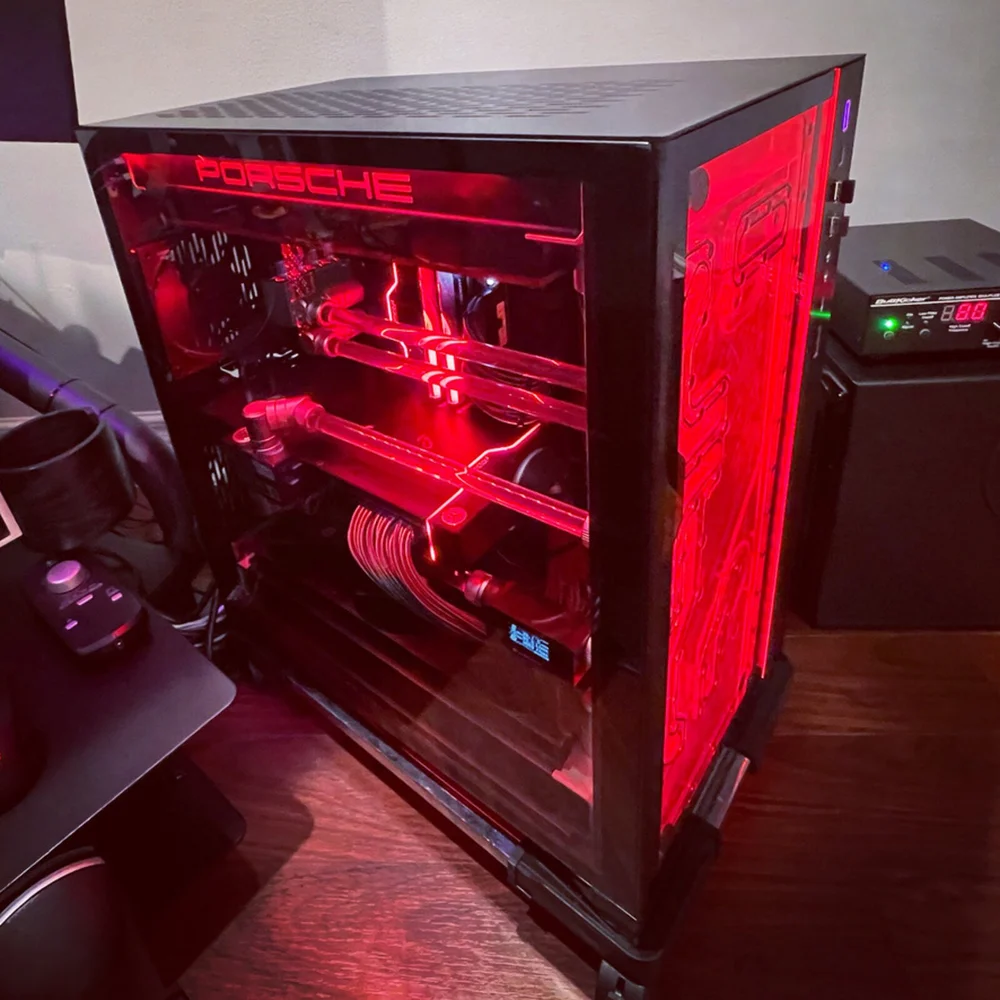
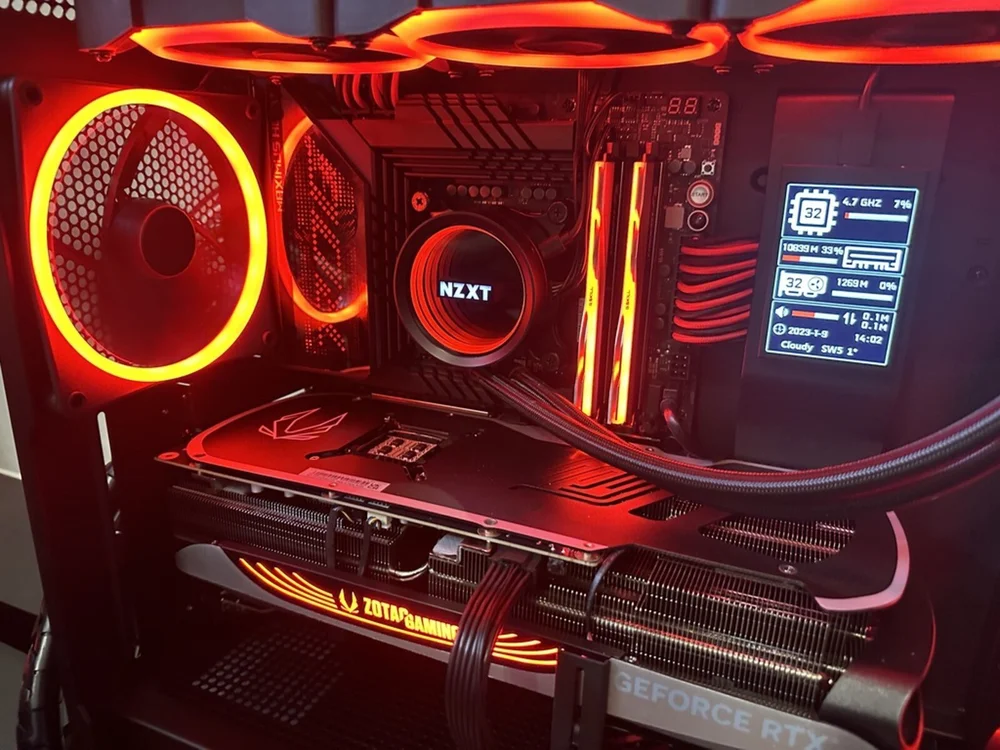
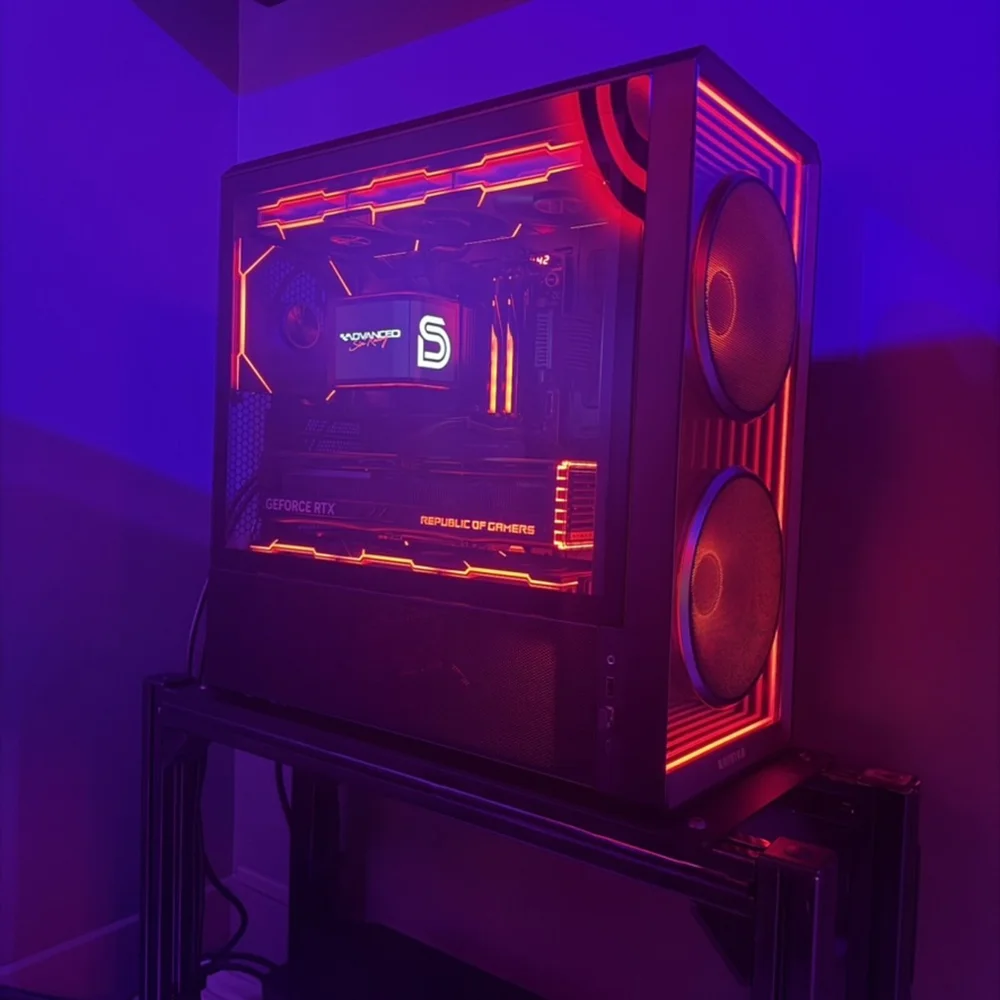
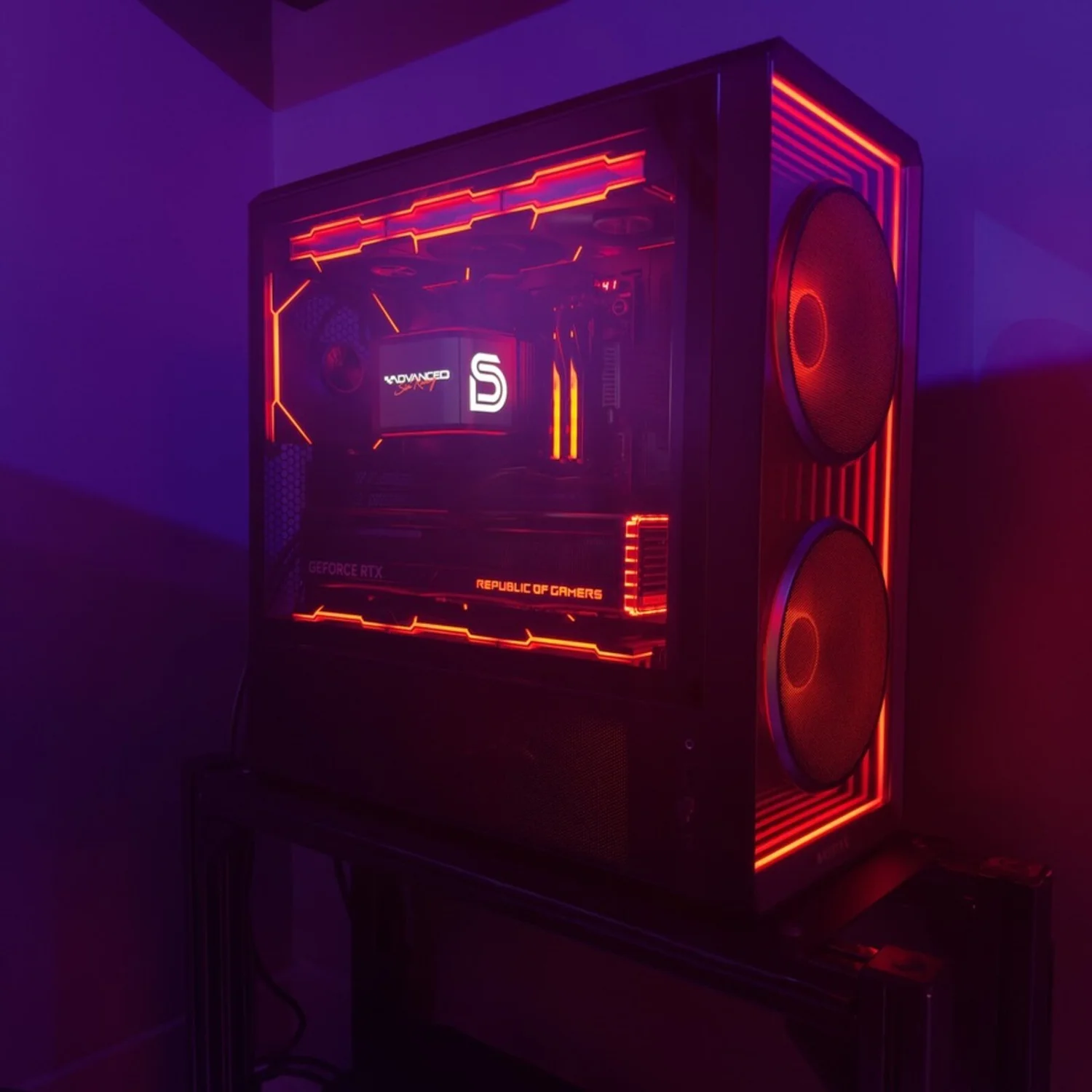
Three machines, one continuous project. Almost nothing carried across all three.
I built a machine years ago and it has been an ongoing process ever since — tweaking, upgrading, swapping parts when it made sense to. Ask me when I built the PC that is in my rig right now and I honestly could not tell you, because there is no single date. There is a continuous line from something I put together a long time ago to what sits under the desk today.
I think that is the normal way these machines come to exist, and almost nobody writes about it, because “replace one part every so often” does not make for a satisfying parts list.
In 2026 it is also the only sensible strategy.
Which part first?
The honest answer is: find out what is actually limiting you before you spend anything. Run the sim, bring up whatever performance overlay you like, and watch it during a busy race rather than an empty practice session.
- Graphics card at 95–100%, frame rate too low — you are GPU-limited. More card, or fewer pixels, or lower settings.
- Graphics card well under 100% and the frame rate still will not rise — you are CPU-limited. A faster card will do nothing. This is extremely common in sim racing and it is the mistake the standard gaming advice walks you straight into.
- Average looks fine but it stutters — look at frame pacing and your worst frames, not the average, and look at what else is running. There is a section on that below.
- It only falls apart at race starts — that is the CPU and the draw-call load. Welcome to the genre.
The platform question
One thing worth knowing before you upgrade a CPU: check whether your motherboard can take a newer chip. A socket that still has upgrade path left is worth real money over the life of a machine, because it turns a whole-platform replacement — board, memory and processor together — into a single part swap.
That is precisely the trap right now. In 2026, “I need new memory as well” can add several hundred dollars to what looked like a CPU upgrade. Check first.
A note on brand
I ran Intel for years. I switched to AMD and I find it much better for this.
I am not going to pretend that is a benchmark — it is my experience, on my machine, running the sim I run. But the architectural reason underneath it is real and it is the same one this whole guide keeps circling: sim racing is a serialised, cache-hungry workload, and AMD’s stacked-cache chips suit it.
The sim is not the only thing running
Every PC guide benchmarks the sim alone. Nobody races that way.
Here is what is actually running on my machine during a session:
- SimHub — driving dash displays and effects
- Dash displays — a second screen rendering live telemetry
- Qubic Manager — the motion platform software
- Crew Chief — spotter and race engineer audio
- Trading Paints — custom liveries
- Simucube Tuner — wheelbase tuning, when I am working on force feedback
- Discord — occasionally, when I am racing with people and chatting
I do not stream, so there is no recording software in that list. If you do stream, add that on top of everything above.
Why this matters more than it sounds
Go back to the earlier section. iRacing’s physics has one core and a 16.7 millisecond deadline, and its renderer submits draw calls from one thread. Anything that interrupts those two threads costs you — not in average frame rate, where it barely shows, but in the occasional late frame you feel as a stutter.
And it is not only CPU time:
- A second display rendering a live dash is a real graphics workload running alongside your sim, not a free widget.
- Telemetry software polls the sim continuously, by design.
- Your peripherals are a load too. A direct-drive wheelbase, load-cell pedals, a switch panel, a Stream Deck, a handbrake, a motion platform — each generates USB traffic and interrupts. Individually trivial. Collectively not nothing.
- Motion software is running a control loop against live telemetry the entire time you are driving.
What to do about it
Give it headroom. This is the best argument for a CPU with more cores than the sim strictly needs — not because the sim uses them, but because everything else can get out of its way. It is also the best argument against buying the absolute cheapest processor that benchmarks well in a clean-room test.
Add things one at a time. If you install five utilities in a weekend and your frame pacing goes off, you will never work out which one did it.
Test the way you race. Benchmark with your dash running, your motion software live, Crew Chief talking and your overlays on. A number produced with all of that closed is a number about a machine you never actually use.
Spread the USB load. If you are running a lot of devices, do not hang all of them off one hub or one controller.
If you are adding a motion platform to all of this, my motion guide covers what that does to the rest of your setup.
What I would do differently
Two things, and one of them will be unpopular.
I would have switched to AMD sooner
I stayed on Intel longer than I should have. The 9800X3D launching was the moment I made the change, and that turned out to be the right time — but the reasoning had been valid for a while before I acted on it.
If you are on an older Intel platform and your graphics card is fine, that is the upgrade I would look at first. It is also, as covered above, the cheapest it has been.
I would never build a custom watercooled PC again
Fun. Not worth it in the end.
I have done it. It looks superb, it is genuinely enjoyable to plan and assemble, and I would not do it a second time. A modern all-in-one cooler handles a sim racing workload without drama, costs a fraction as much, takes an afternoon rather than a weekend, and — the part people underestimate — does not need maintaining. A custom loop is a project you own forever, not a component you install once.
I run an all-in-one now.
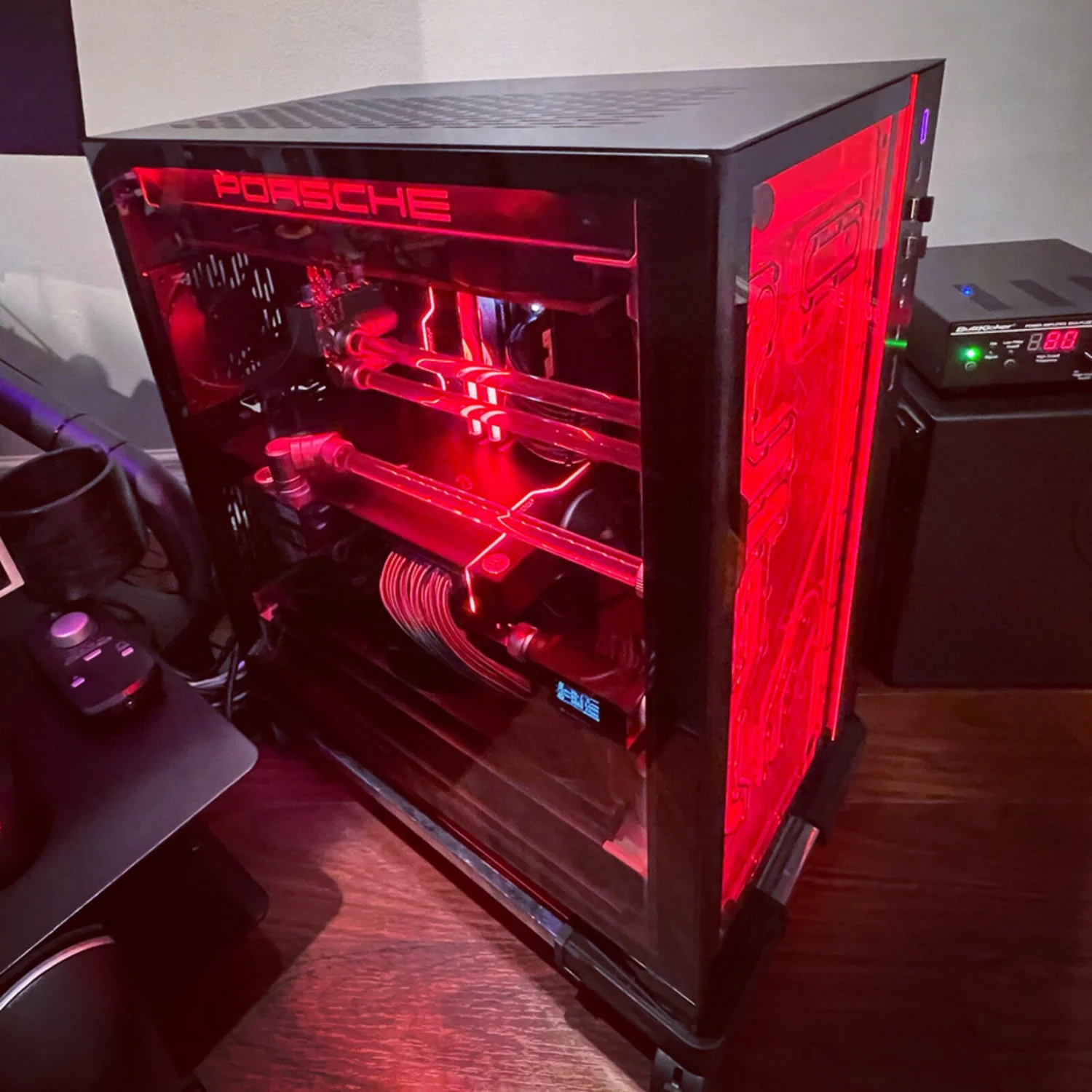
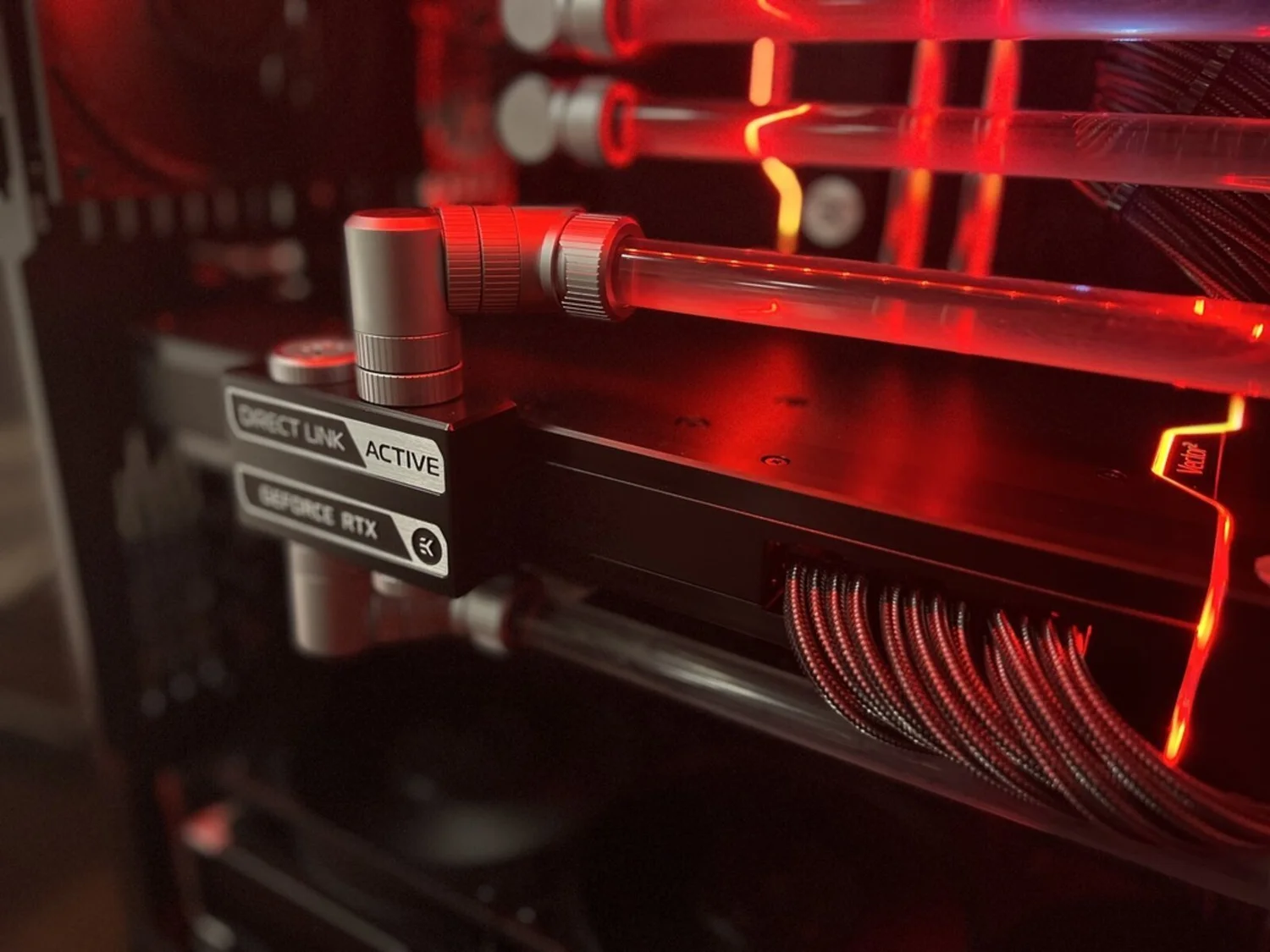
There is a broader point in there. A lot of what makes a PC look like an enthusiast build — the loop, the lighting, the case with the glass panel — contributes nothing to how the car feels through the wheel. In a year where memory has quadrupled in price, that money has somewhere better to go. Most of it should probably go to the rig.
The general lesson
The PC is not the point. It is the thing that lets you drive.
Spend what it takes to hold a steady frame rate at the resolution you actually have, through the worst moment of a race rather than the best. Then stop, and put the rest into the parts you physically touch — the wheelbase, the pedals, the seat, the screens. Those are what you feel.
That has been true for years. In 2026, with a graphics card costing what a decent wheelbase costs, it is truer than it has ever been.
Planning an upgrade?
Check the discount directory before you order. A brand appearing there does not mean every product carries a discount — codes, affiliate-only links and restrictions are listed per brand.
Going deeper
- Monitors, triples or VR? → — the screens that decide your graphics card.
- So you want to add motion? → — what a platform adds to the load, and to your room.
- My setup → — the full parts list, PC included.
- All reviews → — hardware I have actually tested.