
Pedals / Comparison
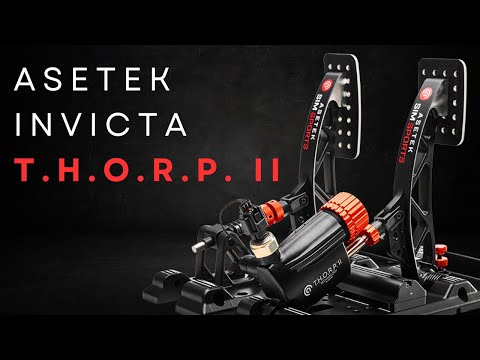
Asetek Invicta-S: Original vs T.H.O.R.P. II
The S-Series layout improved pedal positioning. T.H.O.R.P. II changed the brake feel that had kept me from settling on the earlier Invicta.
Review disclosure: Asetek supplied both S-Series brake-and-throttle review sets. I retained the T.H.O.R.P. II review unit. My earlier three-pedal Invicta set was a separate purchase made with my own money. Asetek shopping links are affiliate links and may earn me a commission at no extra cost to you.
My verdict
T.H.O.R.P. II addressed the part I had struggled with.
I could appreciate the original brake without wanting its firm, short-travel character for every session. The revised mechanism gave me a more usable first stage and easier modulation while keeping a firm second stage. That was a meaningful improvement for my preferences, rather than a reason every satisfied Invicta owner must upgrade.
Check the Asetek discount and buying options →
At a glance
| What mattered to me | Original Invicta S | Invicta-S T.H.O.R.P. II |
|---|---|---|
| Brake progression | Short first stage followed by a very firm stage | More usable movement before reaching the firm stage |
| Tuning experience | Elastomers changed resistance within a fairly specific character | Easy changes encouraged me to try the available feel |
| Preferred setting in the later test | Not directly equivalent across generations | Standard red-orange elastomer and standard end cap |
| Pedal spacing | Independent brake and throttle placement | The same S-Series positioning benefit |
| Details I still wanted improved | Heel plates, aggressive faces and throttle end stop | Faces, exposed wire, base sections and mounting access |
Table summarises my original review findings and the configurations tested. Source reviews and manufacturer references are linked below.
Separate layout and a revised brake are different changes
The S in Invicta S refers to the separated pedal layout. It let me place the throttle and brake independently, which suited my two-foot driving position. That change was useful, but it did not transform the original hydraulic brake into a longer, softer pedal.
T.H.O.R.P. II is the more consequential distinction for this comparison. It revised the brake mechanism and the way I could approach its firm second stage. Someone shopping by the Invicta name alone could miss the part that changed my opinion.
I reviewed a brake-and-throttle pair in both S-Series tests. The optional clutch was not included in those new review packages; my earlier clutch impressions came from the separate set I had bought.
What I found difficult about the earlier brake
The original T.H.O.R.P. system had a short initial movement followed by a very firm stage. Pressure still controlled the braking input, but the physical feel was specific. I understood its purpose and could learn to modulate it without finding it the most comfortable choice for every session.
I used the medium elastomer for much of that review, and it could be tiring over a longer stint. A softer option made the firm stage easier to reach, but it did not turn the underlying mechanism into a completely different style of brake.
Changing calibration also needed to be understood properly. Lowering the force required for full in-game braking did not itself create more physical travel. That distinction mattered when deciding whether the earlier design suited me.
The first stage is where T.H.O.R.P. II won me over
The newer brake gave me noticeably more room to work before reaching the hard stage. I found that easier to modulate while trailing off the brake or easing into a tighter corner. It still felt secure and deliberate, rather than vague.
The firm second stage remained. My improvement was the progression into it, not the removal of the character Invicta owners might already like. Asetek’s current product description also distinguishes the revised travel and force adjustments; my judgement comes from how that arrangement felt in use.
There was an audible click when the mechanism reached the firm stage. It surprised me initially and is worth knowing about, although it did not spoil the test. Reaching that stage was not automatically the same thing as reaching my calibrated maximum braking input.
Adjustment became something I wanted to use
The locking ring and cap arrangement made elastomer changes straightforward. I tried the range rather than leaving the pedal on the first setting that was merely usable.
The softest olive-green insert felt too mushy for me, with an abrupt transition. Dark green was still softer than I wanted, while dark red went too far in the other direction. I returned to the standard red-orange elastomer.
I also tried the alternate end cap with a longer pin, which shortened the travel before the hard stop. I preferred the standard arrangement’s extra movement. The value was having that choice, not assuming the shortest travel was the most serious setting.
Better braking did not fix every detail
I still preferred smoother Forte pedal faces because I often race in socks. The thin exposed sensor wire remained a detail I wanted better protected or integrated. I was also unconvinced by the raised base sections and how they worked with my preferred heel-rest arrangement.
The updated housing obstructed access to one mounting hole on my S-Series review unit. The overall construction was solid, but fitting it was not automatically easier just because the brake mechanism was newer.
The throttle was essentially familiar: smooth resistance and a firm end stop. The reason I would revisit this set was the brake, not an expectation that every component had been redesigned.
Would I upgrade an existing set?
If the earlier brake feels too abrupt or restrictive to you, T.H.O.R.P. II deserves attention. It addressed those concerns for me and made the Invicta much more persuasive.
If you already enjoy your original Invicta, I would first identify what you actually want to change. A newer generation is not automatically a necessary purchase.
Asetek currently lists a T.H.O.R.P. II hydraulic upgrade kit. I have not tested installing that kit into every earlier pedal version. Confirm compatibility, included parts and installation guidance for your exact set before choosing a kit over a complete replacement.
My reviews quoted US$799.99 for the original S pair in July 2024 and US$849.99 for the later pair in May 2025. Those are historical prices for complete sets, not today’s upgrade cost. Compare the current regional quote and any faces, mounting parts or optional clutch you want.
Before you buy
Choose the right setup.
SIMRACINGDEN is listed for 5% off eligible Asetek purchases. Use the correct regional store and confirm the final discount at checkout. Do not assume the upgrade kit or every promotion qualifies. The current product link leads to T.H.O.R.P. II, not the original set.
5% off eligible Asetek purchases
SIMRACINGDENApply the code at checkout.
Product and offer references checked September 13, 2026. Confirm the selected product, region, accessories and final price at checkout. Browse other discounts →
Read the full reviews
Watch the original videos

Sources and current product information
The opinions above are adapted from my linked reviews and their original testing. Manufacturer references provide product context; they do not represent a new driving test.